The problem
Firestore’s security rules are deny-all for clients. The browser SDK is used for Firebase Auth and nothing else; every read and write goes through the Admin SDK on the server — and the Admin SDK bypasses rules entirely.
That is a deliberate trade, and it has a bill attached. There is no database-level backstop. If one server action forgets to check who is asking, one agent reads another agent’s buyers — names, mobile numbers, and what those people said about a property while believing it stayed anonymous. The rules file cannot save you, because you turned it off on purpose. Every authorisation decision is now application code, so the only defensible version is one where that code is small enough to audit and ordered correctly enough to trust.
Architecture & why
flowchart TD
  R["Request → /console/campaigns/{id}"] --> P["1 · Edge proxy<br/>cookie PRESENT? redirect if not<br/><i>reads no attendee data — edge is non-AU compute</i>"]
  P --> A["2 · requireAgent()<br/>verifySessionCookie(checkRevoked)<br/>+ allowlist re-check, every request"]
  A --> O["3 · requireOwnedCampaign(campaignId, agentId)<br/>await FIRST — never raced in Promise.all"]
  O -->|"owns it"| Y["Campaign returned → reused, not re-fetched"]
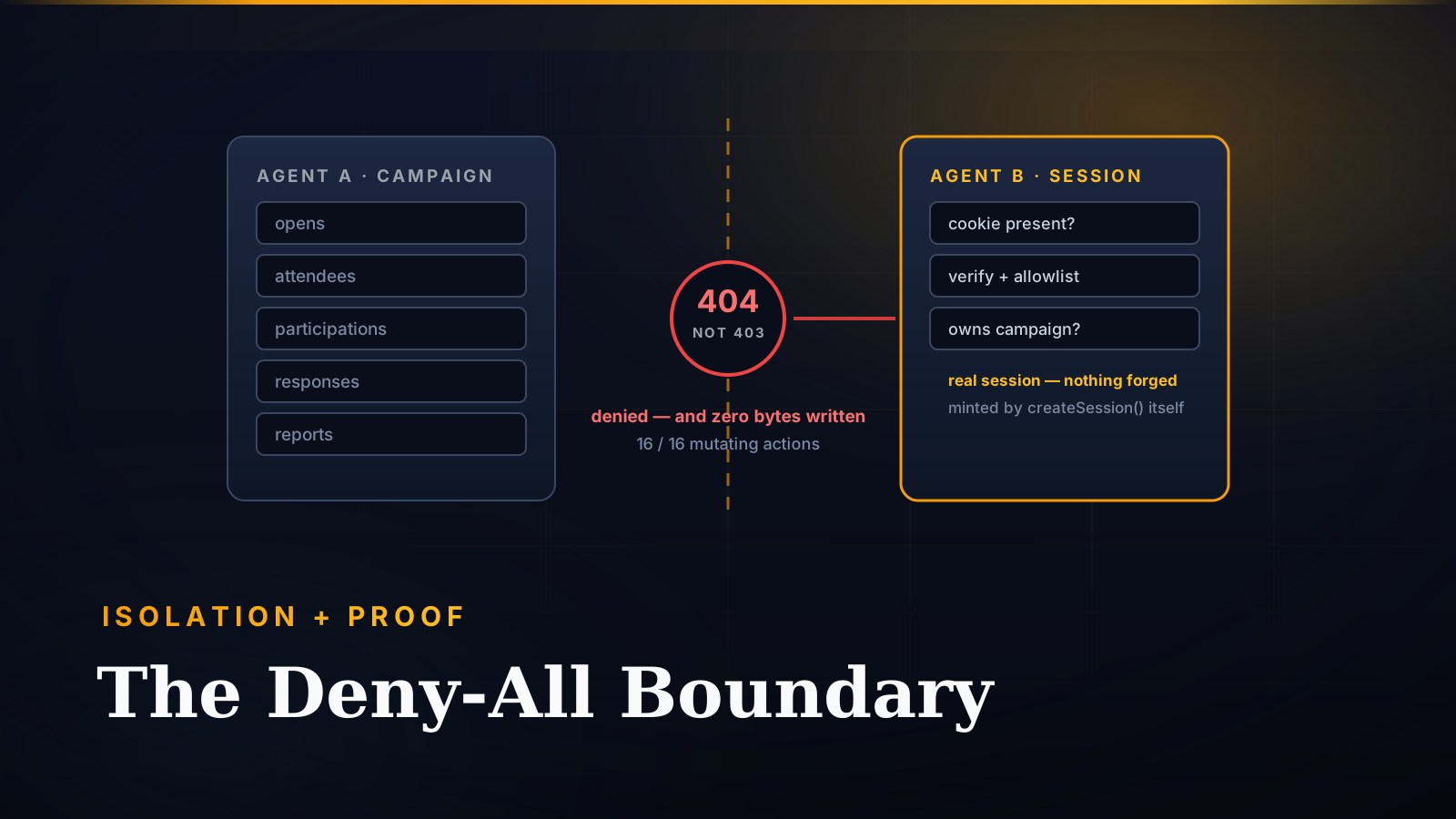
  O -->|"doesn't own it, or doesn't exist"| N["notFound() — 404, never 403"]
  Y --> S["opens · attendees · participations<br/>responses · reports<br/><i>subcollections — protected transitively</i>"]
-
Decision: deny-all rules plus server-side checks, rather than token-scoped client rules. Alternative rejected: per-token Firestore rules letting unauthenticated buyers read their own survey document directly. Why: rules for unauthenticated token-scoped reads are fiddly and easy to get subtly wrong, and the blast radius of “subtly wrong” here is attendee PII. A deny-all rule set with authorisation in reviewable server code is a smaller, more auditable attack surface — provided you then treat that server code as the security boundary it now is.
-
Decision: one data-access module is the only legal import surface. Alternative rejected: importing
firebase-adminwherever a query is convenient. Why: with the rules enforcing nothing, the property worth having is “every read and write in this system goes through one directory.” Adding a query means adding a function there. Reaching around it doesn’t just break a convention — it defeats the entire authorisation model, so the rule is stated in project memory as a hard invariant rather than left to taste. -
Decision: three layers, each doing one job, none a substitute for another. Alternative rejected: a single middleware check, which is what most App Router codebases do. Why: middleware runs at the edge, and the edge is non-Australian compute — reading attendee data there is a cross-border disclosure under APP 8. So layer 1 checks cookie presence and redirects, deliberately reading nothing. Layer 2 does the real verification. Layer 3 is the per-agent boundary.
-
Decision: nest everything under the campaign. Opens, attendees, participations, responses and reports are all subcollections of
campaigns/{campaignId}, so one ownership check at the campaign boundary transitively protects everything beneath it. Alternative rejected: top-level collections carrying acampaignIdfield. Why: those look identical in a data browser and behave completely differently — a new top-level collection silently escapes the boundary, and nothing fails to tell you. -
Decision:
requireOwnedCampaignisawaited before any campaign-scoped read, never racing it in aPromise.all. Alternative rejected: the obvious parallelisation, saving a round-trip on every console page. Why: racing them means the nested read is already in flight when ownership is denied — and on the two pages that also write, it means writing on behalf of an agent who does not own the campaign. Those two carry a comment marking the ordering as load-bearing, because it looks exactly like a missed optimisation to the next person who reads it. -
Decision: 404, never 403. Alternative rejected: an honest “forbidden”. Why: a 403 confirms the thing exists. A non-owned campaign and a non-existent one must be indistinguishable, and the admin surface must not reveal it exists to a signed-in non-admin.
-
Decision: fail closed as the default shape, not as error handling. Environment accessors return
nullwhen unset and every caller treats that as deny — an empty admin list means nobody is an admin, an unset cron secret refuses every cron hit, a missing campaign is denied. Two of these were bugs once:verifySessionCookieis called withcheckRevoked, without which a 14-day cookie outlives the Firebase user being disabled or deleted; and the allowlist’s Firestore read is bounded at 3 seconds with the timeout resolving to “not a match”, so an unreachable Firestore degrades fast and closed instead of hanging 45 seconds into a gateway timeout.
Evals / validation
The suite’s defining property is that nothing is forged. It signs in through the Auth emulator’s REST API for a genuine ID token, exchanges it at the app’s own POST /api/auth/session, and uses the session cookie that createSession() actually minted. So the allowlist gate, the email_verified gate and requireOwnedCampaign all execute exactly as they would for a browser — a suite that hand-built a cookie would prove nothing about the code that checks it.
- The mutation harness is the centrepiece: all 16 campaign-scoped mutating server actions, each invoked as agent B against agent A’s campaign. Server actions can’t be driven over HTTP without Next’s build-time action ids, so they’re called in-process with only Next’s request-context modules stubbed —
next/headersreturns agent B’s real session cookie,next/navigationthrows catchable sentinels. Every security-relevant step still runs for real. Each action must satisfy two conditions: thrownotFound(), and leave agent A’s data byte-identical, verified by snapshotting before and after every single call. A denial that quietly wrote first would pass a naive assertion and fail this one. - A control case that proves the harness isn’t lying. The same action against agent B’s own campaign must succeed — otherwise 16 green 404s are equally consistent with a correct boundary and a broken test rig.
- 71 pass/fail checks across the HTTP walkthrough (GET surfaces 404 for a second agent, an outsider, and an
email_verified: falseaddress), the onboarding and access-request queue, and the remaining spec scenarios. - A fail-closed drill that runs as its own process, because it needs environment the application can never be in: the env allowlist fallbacks unset — otherwise they’d grant access without a Firestore read and the collection’s real behaviour would never be exercised — and Firestore pointed at a dead port. Four probes: healthy member ⇒ granted, empty allowlist ⇒ denied, blank email ⇒ denied, unreadable allowlist with a genuine member ⇒ denied. Crucially, a throw is reported as its own outcome and is not a pass: a 500 is not a denial, and the distinction is the whole point of the drill.
- 148 unit tests across 22 files on the pure modules the gates are built from — allowlist normalisation and parsing, campaign ownership, the purge clock, scoring, funnel maths — each kept dependency-free specifically so the membership rules are directly testable without a server.
Outcome
- 16 of 16 mutating actions denied across the boundary, with agent A’s data byte-identical after every attempt — the “denied but wrote anyway” failure mode is excluded by construction, not by inspection.
- Zero forged credentials in the entire suite. Every session it uses was minted by the application’s own sign-in path.
- An unreachable allowlist backend degrades in ~3 seconds to denied rather than hanging into a gateway timeout — and the drill proves the difference between denying and merely erroring.
- The isolation rules are written down as requirements with WHEN/THEN scenarios, not carried as tribal knowledge — including the ones that are counter-intuitive enough to be “optimised away” later: await ordering, 404-never-403, and the ban on new top-level campaign-keyed collections.
Built solo. The threat model here is mundane and unglamorous — no attacker, just an ordinary missing check on an ordinary Tuesday — which is exactly why the proof has to be mechanical rather than a reading of the code.