The problem
A data pipeline depends on a fresh weekly feed pulled together from dozens of third-party sites that have no API and no shared format. A fleet of ~40 fragile browser-automation jobs has to run on its own every week and commit a large Git-LFS file safely — while main keeps changing underneath it. Build this carelessly and you lose the entire week’s data the moment one source breaks, a runner crashes, or the push gets rejected.
Architecture & why
To be clear about credit: most of the individual scrapers are a colleague’s. What I built is the CI orchestration, the resilience, and the LFS strategy that keep the fleet reliable — not the scrapers themselves.
flowchart TD
  A["Weekly cron"] --> L["list: find all the scrapers → build a job list"]
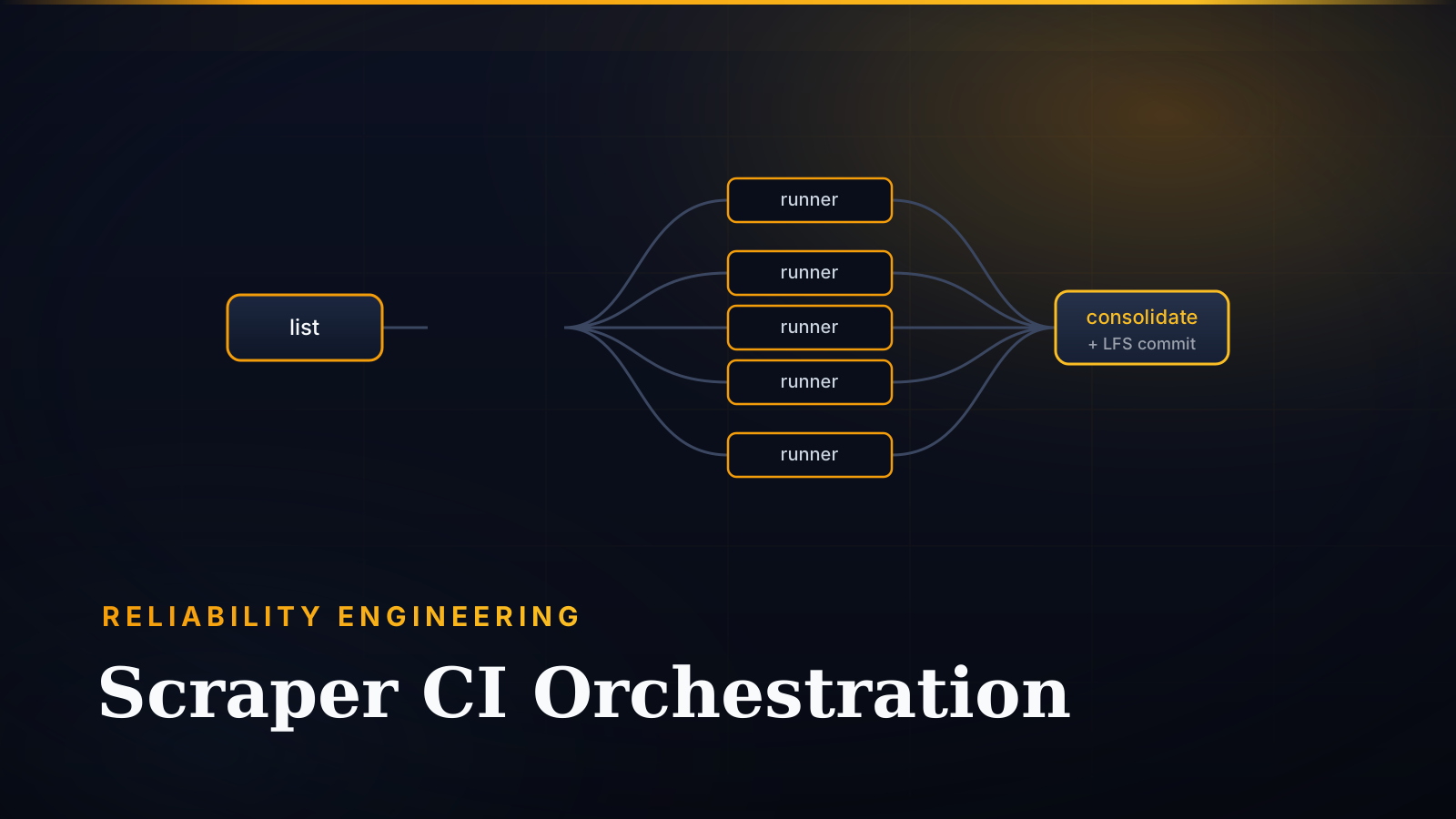
  L --> S["scrape: run them in parallel (up to 10 at once),<br/>don't cancel the rest if one fails"]
  S --> C["consolidate: run as long as the list step succeeded,<br/>even if some scrapers failed"]
  C --> CM["LFS-safe commit loop:<br/>snapshot → hard reset → pull LFS files → restore<br/>→ push LFS files → push commit → retry ×3"]
  C -. "no data came back at all" .-> INF["flag an infrastructure failure"]
  F["workflow failed & this is attempt 1"] --> R["auto-rerun ONLY jobs with an empty step list<br/>(= the runner crashed, not a real bug)"]
- Decision: split the work into three stages — list the scrapers, run them in parallel, then combine the results. Alternative rejected: scraping everything in one big loop in a single process. Why: in one loop, a single slow, broken, or blocked source takes down all the others. Running each source in its own isolated job, with
fail-fast: falseso a failure doesn’t cancel the rest, means one broken source can’t block the others — and a combine step that always runs still commits whatever did succeed. - Decision: a commit loop that snapshots the data → hard-resets → pulls the LFS files → restores the data → commits → retries on top of the latest
main. Alternative rejected: a plaingit push(which gets rejected the momentmainmoves) and, earlier, agit reset --soft. Why:reset --softleft the staged files pointing at the commit the run started from. So whenmainmoved mid-run, the next commit’s diff silently deleted every file other people had added upstream — including workflow files the token isn’t even allowed to push back. The hard-reset-plus-restore approach makes the commit contain only the new data and nothing else. And pushing the large LFS files before the commit that points to them clears the rejection GitHub otherwise throws. That last point is the key insight the whole thing hangs on. - Decision: tell infrastructure failures apart from source failures, and only auto-rerun within a limit. Alternative rejected: “rerun the whole workflow whenever anything fails,” and treating every failed run as a real bug. Why: rerunning everything pays the full cost of the whole fleet again (and risks an infinite loop) just to recover from a runner that crashed for a few seconds. So I only flag an infrastructure failure when no data comes back at all, and I only auto-rerun failed jobs whose step list is empty — the tell-tale sign of a hosted runner crashing rather than a real bug — and only up to a set number of attempts. That retries only the failures that are genuinely recoverable.
- Decision: commit the raw rows before the expensive post-processing step, and protect every PR with a live smoke test. Alternative rejected: processing and committing in one shot, and trusting the page selectors until the weekly run breaks. Why: post-processing can hit its time limit, so committing the raw rows first means a timeout never throws away the scrape you already paid for. And a smoke test that runs one source end to end on every PR catches a broken selector as a red check before it ever reaches the weekly schedule. (Selectors are the rules that pick data out of a page; sites change, so they quietly rot.)
Evals / validation
- Failure isolation, measured: up to 10 sources running at once with
fail-fast: false, a hard timeout per source (raised over time as the heaviest sources kept hitting it), empty results turned into a clean empty set so the combine step never chokes on them, and a screenshot saved whenever a source fails so I can see what broke. - Safe commits under concurrency: up to three push retries with a growing wait between them, a hard failure after the third, and the large LFS files always pushed before the commit that points to them.
- Crash recovery, bounded: the auto-rerun only fires on failed jobs with an empty step list, and only up to a set number of attempts, so it can’t loop forever. A shared retry helper (3 attempts, growing wait, only for errors that look temporary) wraps the flaky page-navigation calls.
- Honest gaps: the timeout is “a signal to cut scope,” not a real fix. The proper replacement — scrapers that manage their own time budget and can resume from a checkpoint — is specced but not built yet, and the wait-for-deploy step sleeps for a fixed time instead of checking when the deploy is actually done. Both are flagged as next steps.
Outcome
- One broken source used to sink the whole run → now isolated: running each source on its own means a failing source no longer cancels the others. The pipeline has run on a weekly schedule in production for months on this design.
- Commits used to corrupt data or get rejected → now safe under concurrency: the snapshot / hard-reset / retry loop survives
mainmoving mid-run, and the LFS-push fix cleared the rejection, so the large Git-LFS file commits reliably every week. - Runner crashes used to waste whole runs → now auto-recovered: the empty-step-list check tells an infrastructure crash apart from a real bug, so only the recoverable failures retry.
- A concrete speed win: the slowest source’s weekly run was cut by roughly 27× (from well over an hour to a few minutes) by making its most expensive phase opt-in — which also got rid of a recurring timeout that kept cancelling it.
Built at storipro. This is reliability and distributed-systems engineering, not scraper authorship. Most of the individual scrapers are a colleague’s. The orchestration, the LFS-safe commit strategy, and the failure taxonomy are mine. Source and domain specifics are intentionally omitted.