The problem
A non-technical co-founder has plenty of product ideas, but he can’t start any of them on his own. The two engineers are the only ones who can build them. So good ideas die in the gap between the two. The bet: let him describe an idea and get back a clickable, on-brand prototype on a preview link, with no engineer needed to start it — while engineers stay the only people who can merge.
Do this carelessly and it’s dangerous. You’re letting an AI agent run inside the real repo, driven by a brief that a non-engineer wrote and that you can’t fully trust. Things that can go wrong: prompt injection, the agent writing files outside its sandbox, leaked secrets, and runaway spend. So the real question wasn’t can an agent build a prototype. It was where do you draw the line on what the agent is trusted to do.
Architecture & why
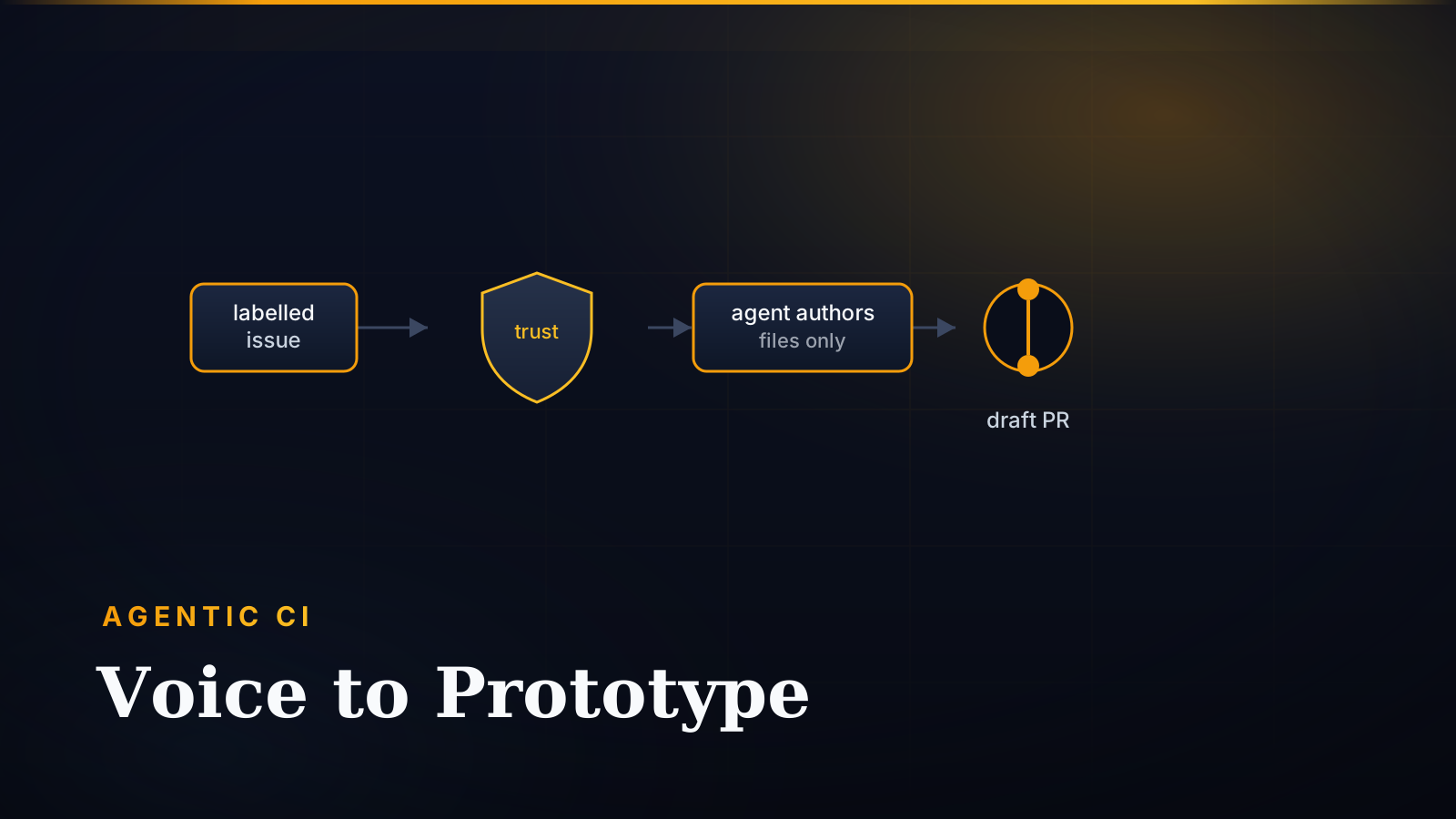
flowchart TD
  A["Idea → labelled issue<br/>(template adds the label for you)"] --> B{"Permission check:<br/>does the author have repo access?"}
  B -- "no" --> X["Post a comment explaining why<br/>(don't just skip silently)"]
  B -- "yes" --> C["Constrained Claude Code<br/>writes files only"]
  C --> D["Deterministic workflow:<br/>branch · commit files · push · open draft PR"]
  D --> E["Vercel preview link"]
- Decision: the automated workflow does all the git and PR work; the agent only writes files. Alternative rejected: letting the agent (or the Claude Code action) run
git/ghitself. Why: both proved unreliable when I tested them live. The model would finish its turns and never open the PR, and the action doesn’t auto-push on issue events at all. A step that must happen every time can’t be left to an agent whose behaviour varies run to run. So the AI writes the code, and the workflow handles the plumbing. - Decision: check the author’s actual repo permission level, not
author_association. Alternative rejected: the obvious check that the author is anOWNER,MEMBER, orCOLLABORATOR(author_association). Why:author_associationreportsNONEfor members of a private org, so that check silently skipped the owner’s own runs. Permission level works the same whether the org is public or private, and it still handles the case I wanted — an outside collaborator running the pipeline. - Decision: treat the issue text as data to act on, never as instructions to obey. Alternative rejected: pasting the issue text straight into the prompt or a shell command. Why: text a non-engineer wrote, fed into an agent running in the repo, opens the door to both prompt injection (the text hijacking the AI) and shell injection (the text running as a command). So I label the brief as product-brief-only and pass it in through an environment variable instead of pasting it inline.
- Decision: keep prototype previews and prototype spend separate from the real app. Alternative rejected: rendering the real signed-in app on previews and reusing the org-wide API key. Why: per-branch preview URLs aren’t on the list of domains allowed to sign in, so a real login can’t work there anyway — keeping previews on their own routes was forced, not a choice. And a dedicated key with its own spend cap stops prototype runs from slowing down other pipelines and tracks their cost on its own (~$5 per ~50 runs).
Evals / validation
The validation is the debugging arc. I merged a 4-PR sequence in ~75 minutes, and each PR is a live debugging log that disproves an assumption the previous run had relied on:
- The permission check silently skipped the owner’s own run (
author_associationreadsNONEfor members of a private org). - The model generated a correct page but ran out of turns before it opened the PR.
- My fallback assumed the action would auto-push on issue events — but that was also false, so fix #2 was built on a wrong premise and had to be replaced.
I handle failures explicitly. The commit step works whether the agent left files uncommitted or committed them locally. A “this run produced nothing” guard stops empty runs early. Authors without access get a comment, not a silent skip. And several guardrails act as quality gates: the model is pinned to a fixed version, the number of turns is capped, the agent’s tools are limited to an allowlist, and there’s a best-effort per-author rate cap.
Outcome
A clean design where the model writes the code and the automated workflow handles git. I got there by debugging a flawed first design — two unreliable agents — across three real failures I hit while testing. The intended flow (spoken idea → labelled issue → constrained agent run → draft PR → preview link) passes end to end in dry runs, with zero engineers needed to start a prototype and merge still fully gated.
Held honestly: it was never run as a live production generation, and is on hold behind a product pivot. Even setting the pivot aside, it was already blocked by two org-level limits. Branch protection requires a paid GitHub plan. And giving the co-founder repo access would expose the PII in bug-report issues — the same access that lets him run the pipeline is the access that exposes the PII. The lasting deliverable is the design itself, plus a candid write-up that’s clear about the difference between “passes in dry runs” and “rolled out”, with the failure analysis written down rather than glossed over.
Built at storipro (100% mine). Framed honestly: a built-and-merged pipeline, proven through dry runs, parked behind a pivot. Not a shipped production feature.